Monday, March 26, 2018

Clicker Expo St. Louis: Day 3

Better late than never, amirite?

Dr. No: How Teaching an Animal to Say "No" can be the Right Prescription with Ken Ramirez
I wish I could start every day with Ken Ramirez. He's almost better than coffee.
Ken was careful to start this presentation by pointing out that this isn't required training for most animals. It was a single case study, something that was an appropriate tool for this animal. At the Shed Aquarium, Ken and his staff began to notice that one of their beluga whales, Kayavak, was refusing to work with new or unskilled trainers and would swim away in frustration. Ken wanted to teach Kayavak a way to tell the trainer that she didn't understand or didn't want to do the requested behavior, so he taught her to touch a bouy when as an alternate to swimming away (okay, it was a really complex process, but I only have so much room on the blog). In essence, he taught her to say, "No, I'm not going to do that." With this new tool for control over her training, Kayavak was able to work with trainers of most skill levels, and her use of the "no" option slowly diminished. She continues to have the option to touch the bouy, but she does not use it very often. Ken finished this case study by mentioning again that most trainers will never need to use this tool; skilled trainers are able to realize when their animals are saying "no" without resorting to teaching a specific cue. In the bajillion years that Ken has been training, he's only needed this tool four times. But it worked well for all of those situations, and it was an interesting case study none the less.

Fail-Safe: Cracking the Code for Ultra-Dependability with Hannah Branigan
I adore Hannah. You may have noticed.
This lecture and the following lab worked on the topic of fluency - teaching a dog to perform a behavior with precision, stimulus control, and under a variety of conditions. Fluency training was traditionally called "proofing, but instead of setting up a dog to fail or overcome a difficult distraction, Hannah is a big proponent of "errorless learning." With errorless learning, antecedents are set up to make the behavior extremely likely to occur. Once a behavior is obtained on cue, fluency is taught so subtly that the learner doesn't even realize the behavior is getting "harder." Errorless learning reduces frustration, the risk of accidentally poisoning cues, the practicing of incorrect behaviors, and it improves emotional fluency (the ability to perform the behavior in a stressful environment - like, say, at a trial). In the lab, Hannah outlined her process for fluency training. She starts with a general "Are you okay?" behavior of attention and taking treats. Then she asks for an "easy," well-known and rehearsed behavior like a hand touch. When a dog easy performs that, she moves to a more complicated but still well-known behavior such as a favorite trick. Once she has these zeroed in, Hannah knows the dog is ready to work. She starts working on the target behavior, adding in distractions so slowly that the dog never loses his ability to perfectly perform the behavior.
Another from Hannah because I luves her.
In a totally platonic and not at all creepy way.

Passport to Joyful Training with Michelle Pouliot
There are a lot of reasons to be serious about dog training. It's a high frustration field that encourages perfectionism. Situations often feel life or death because many times, they are life or death. However, most of us got into the field because dog training brings us joy. We wanted to play with doggos all day. It's important for us to remember the joy we brought with us into our jobs. And then we watched funny dog videos for the rest of the presentation, which was perfect for the last day of Clicker Expo.

Spot Remover: Clean Up "Not Quite Right" Behavior with Hannah Branigan
MOAR HANNAH.
In this presentation, Hannah talked about how to remove "junk" behaviors from our fancy competition behavior. Junk means thing like barking, foot shuffles during stays, or rolling the dumbbell during the retrieve. The first step is to identify how the junk behavior snuck in because this will help guide the plan for how to get rid of it. In order to remove the junk behavior, we need to find a way to get "clean" exercises - repetitions of the behavior we want without the junk in it. We may need to change the way we set up (antecedents), change the cue, add an incompatible behavior, increase the rate of reinforcement or change the method of delivering the reinforcement, or add a prop. Minor precision errors rarely require reshaping the entire behavior, which I think is the biggest fear for those of us who have trained junk behaviors (which I'm thinking is probably everyone who's reading this). However, for severe junk or poisoned cues, starting from scratch is always the best plan of action.

Our in Front: Preventative Behavior Services Trainers Can Offer Veterinary Services with Debbie Martin
And then more from the cooperative care movement! Vets and trainers rarely work together, and that's not how the world should operate. After all, we're both working with you on the health of your pet. Here, Debbie outlined several services trainers can offer through veterinary clinics including pet selection counselling, puppy and kitten socialization classes, private lessons, and grooming/medical care classes. Debbie also described "victory" visits for dogs that already have anxiety or aggression issues with vet care. These are structured, one-on-one visits to address specific goals. But as Debbie pointed out: prevention is a lot easier than treatment.

And that, my friends, brings us to the end.


Wednesday, March 21, 2018

Why Mommy Drinks (aka Allister's Near Death Experience)

The staples are coming out today, so I guess we're going to live a little longer.

Sixteen days ago, at 2am on Monday morning, Allister threw up. This isn't particularly unusual for my house; it seems like someone is always throwing up. And isn't 2am always the time they do it? Heaven forbid they should puke at a reasonable hour, when you aren't trying to sleep.

He ate breakfast just fine that morning, and while he didn't tackle dinner with his typical enthusiasm, he got that down, too. Tuesday morning, though, he turned down breakfast, and by Tuesday afternoon when I got home, it was clear he wasn't feeling well: drinking, peeing, pooping, sure - but turning down meals and just listless enough that I called my vet and scheduled a visit for Wednesday morning.

Wednesday morning Allister turned down breakfast, but it was okay because we had a vet appointment, and we'd get this figured out, and everything would be fine. Allister sat quietly next to me in the waiting room, and patiently tolerated all the poking and prodding from the vet. I could tell that she was a little skeptical that he was as sick as I said he was. His exam was normal - a little dehydrated, but really not bad for a dog that hadn't eaten in a day and a half - and this particular vet had never met him. However, she brought him back for labs (Allister is my one dog that does better with blood draws if I'm not there), and at least four people stopped her to ask if he was alright. He wasn't barking! I think that's what really convinced her that he was sick.

His labs came back weird. Allister was a touch dehydrated, which should have brought his lab values up, but his potassium and sodium were low. He also tested positive for Lymes disease, but he didn't have any joint pain, a hallmark of the disease. He wasn't eating his meals, but he took kibble from me throughout the exam. He'd pooped yesterday and was drinking water fine. The vet was convinced something was wrong, but nothing fit. We discussed a variety of scenarios, including the possibility that the office's blood machine needed recalibration. After all, they were a clinic, not a lab. In the end, we redrew blood to send out and gave Allister sub-q fluids and a shot of cerenia (a potent anti-nausea med). We scheduled a follow up visit for the next day, and Allister and I went home without any answers.


My plan was to teach class Thursday morning and bring Allister to the vet afterward. But partway through class, I received an urgent call from the vet: "His labs are back, and they're much worse than we thought. He needs to be hospitalized as soon as possible."

We rushed to the Oakdale Animal Emergency and Referral Center where Allister was started on fluids and xrays were taken. The xrays showed a distended section of bowel the size and length of a bratwurst, a finding that strongly suggested a bowel obstruction. But he wasn't throwing up! He had eaten as recently as the day before! The emergency vet agreed that it was strange, and asked to do an ultrasound. The ultrasound took another hour or two to complete, but the results were back almost immediately.

The vet came into the room and sat across from me. "There's definitely a foreign body in his bowel. It's probably something organic, which is why we didn't see it on x-ray. His bowels are in pretty rough shape, though, and it needs to come out as soon as possible." She hesitated a moment, watching me. "We also found masses on his spleen and liver. They could be benign. But there's also a reasonable chance that it's cancer."

And I lost it.

(I feel bad for veterinarians - and doctors in general. They get little to no training on how to deliver bad news and handle sobbing patients. It's a really hard way to practice medicine.)

Hemangiosarcoma is an invasive, aggressive, and unfortunately, all too common cancer in dogs. It typically starts in the spleen and then spreads to the liver, then lungs, then heart. It's typically found in medium to large breed males between eight and ten years old, although it can be found in pretty much any breed, sex, or age group.

I'm fortunate to have an extensive support network, and I leaned on them heavily on Thursday. I sat with my husband and we tried to logically decide what to do like intelligent adults and not desperate owners whose hearts were breaking. We could let Allister go today. We could loose him within a week if the surgery didn't go well. We could lose him in three or six months from cancer. Possibly a year. Possibly six years. Or ten - if he didn't have cancer.

As we talked, I sat next to Allister, softly stroking his head and body. Asking him without words, in that way that dog people do, if he wanted to keep going. Or if he wanted to be done. And Allister thumped his tail and rested his head on my knee and told me that he trusted me to make the decision that was right for him.

The staples are coming out today, so I guess we're going to live a little longer.


I'm still not sure that I made the right decision. Actually, if I'm being honest, I'm a bit surprised with myself (us, really - this was definitely a decision we all made together). If you had asked me a month ago if I would choose to do expensive, invasive, and painful surgery on Allister when he very well might have an aggressive metastatic cancer, I think I probably would have told you "no." I think maybe I like Allister more than I thought I did. I know I don't want to lose him.

I have Allister's spleen sitting on my shelf (that's normal, right?). I can see the tumor on it, round and big as a marble - huge on such a tiny organ. I wonder if it's cancer, but I don't think I really want to know. Maybe he'll die in three months. Maybe we have ten years. You never know how much time you've been given.

But perhaps - if you are very, very fortunate - you get the chance to know what you've got before it's gone.


Sunday, March 18, 2018

Clicker Expo St. Louis: Day 2

To St. Louis and beyond! Okay, pretty much just St. Louis. The St. Patrick's Day festivities are in full swing, and I had a blast wandering and watching the parade in between learning sessions. As a bonus, during the book signing tonight I was able to meet Emma Parsons, who you may remember wrote Click to Calm. This was the first book I read when I adopted Maus and realized how deep his rabbit hole went. Maus was a game changer for me; without Maus, I would not be the trainer I am today. And without Click to Calm, Maus would not be the functional, relatively happy dog he is today. I'm so grateful for this book, and I'm extra grateful for the opportunity to tell Emma how much it meant to me and Maus.

Bonus picture of Maus, just in case you forgot what he looks like.


Veterinary Transformation: Fear Free Initiative with Debbie Morgan
Fear free veterinary practice is a newer idea, and it's one I'm really excited about. Many pets don't get routine or even emergency vet care due to fear and/or anxiety. Reducing pet fear and anxiety not only improves medical care for pets and makes for a better experience for owners, it also helps to prevent professional stress and burnout in our veterinary staff. Debbie's presentation on the fear free initiative was one of the lectures I have been really looking forward to, and I wasn't disappointed. Debbie outlined the key concepts of the fear free program to improve physical and emotional well being during medical care. The concepts involved are an approach that considers the how the animal sees the environment, a touch gradient designed with the individual patient in mind, a Fear, Anxiety, and Stress Scale (FAS scale) that allows for concrete assessment of an animal's emotional state, gentle control that is safe and comfortable, and cooperative care training. Like Debbie, I could go on about this topic forever, but time is finite, so I'd encourage anyone who is interested in the fear free movement to explore the Fear Free Pets and Fear Free, Happy Homes websites.  

Please Sir, May I Have Some Food, Water . . . and Control? with Susan Friedman
Control is a big buzzword in dog training right now. Susan makes the argument for control as a positive reinforce just like food or water (or orgasms, just in case you thought behavioral science was boring). Behavior exists as a way to exert control; just like eyes are for seeing and ears are for hearing, behavior is for creating desirable outcomes. In fact, many of the reactivity and aggression issues I work with can be traced back to the dog's inability to control her environment resulting in the creative of maladaptive behaviors - and a lot of behavioral rehabilitation is teaching the owner how to give the dog back her control. The way we give animals control is to give them choices. For example, letting them chose whether or not to engage in a training session or work on a specific husbandry behavior. Of course, sometimes animals don't have a choice in whether or not to do something, like having a broken leg examined or being vaccinated (one of the reason vet care can be difficult). Susan suggests that knowing this, creating a "lifestyle of control" where dogs are frequently allowed and encouraged to exert control over their environment will create an animal that is more resilient to the loss of control. This is true for what we know about humans as well: autonomy, or the belief that you have control over your life, makes you more resilient to difficult situations.


Arousal: Science, Not Sex with Lindsay Wood Brown
Arousal is another buzz word in dog training, and it's one that doesn't have a good definition (oh, Ken). The majority of Lindsay's talk revolved around trying to define what exactly we mean when we talk about arousal. Behavior trainers like myself will describe reactive dogs as having arousal issues, but in sports dogs, high arousal is often a desired trait. What are we talking about? Lindsay makes the argument that arousal is an internal state, like joy or attention, and so we cannot directly change it. While it might seem like it sometimes, there is no "arousal dial" for us to turn one way or another to directly adjust our dog's arousal. Instead, we need to look to environment/antecedents and behaviors to influence arousal. Lindsay proposes that arousal itself is never the issue - arousal does not create or break behavior. Instead, it is genetics, reinforcement history, and environment/antecedents that directly impact behavior.

I'm going to have to roll that one around in my head for a bit because I'm not sure I agree with Lindsay. I mean, not that last bit about genetics, reinforcement, and antecedents, that's solid - I mean the bit about our internal state having no influence on behavior. That doesn't "feel" quite right . . .

Free Cookies? Non-Contingent Reinforcement for Frustration with Sarah Owings
I liked this presentation, probably because it was a concrete tool for my toolbox instead of "just" theory (I love theory, but I've had a lot of it today). Non-contingent reinforcement is an antecedent arrangement strategy. There are several bits and pieces to it, ideas from on person and theory from another. Basically, it's providing free access to a reinforcer without asking or waiting for a behavior. Often, we're told to "wait for quiet" or "wait for calm," and there are many instances where this is not possible for a given dog. Sarah suggests using this tool when the problem behavior is fluent and has low latency (occurs quickly and predictably under certain circumstances), the animal has a narrow repertoire of alternate behaviors it can offer, the reinforcer is safe to deliver (so this is not a tool to use with, say, car chasing), and ignoring the problem behavior actually sets up a system of variable or intermittent reinforcement.

Sarah used several case studies to illustrate use of non-contingent reinforcement, but the one that stuck out for me was the over greeter. Often we're told to ignore our dogs when we get home, and for many dogs, this is fine. They learn that people returning home is not that exciting. However, some dogs escalate their behavior when they don't receive their reinforcement; ignoring results in bruises and torn clothes. In this case, instead of ignoring the dog, Sarah required the owners to give the dog five minutes of calm, undivided attention the instant they got home, no matter what the dog was doing. Because the reinforcer was immediately available, the dog had no need to escalate behavior. Within the space of ten or so sessions, the dog was able to calmly greet it's owners and then disengage on its own. It was striking to watch the change in the dog's behavior, and I'm pleased to have this new tool in my kit.

Animals in Control with Emelie Johnson Vegh, Eva Bertilsson, and Peggy Hogan
Continuing on the theme of control in animal care, Emelie, Eva, and Peggy talked about how to create a "lifestyle of control" (to borrow Susan's term) for our animals. I really, really enjoyed this presentation as it helped me to formalize my thoughts on a lot of the training I've been doing with Kaylee; I've tried to make control and choice a part of her daily life, and I think it's paid off in spades for us. Emelie, Eva, and Peggy divided this topic up into three sections. First, they talked about requests, an animal tells us what reinforcer they want in order to meet their needs. For example, when Kaylee scratches at the door to ask to be let into the yard. Second, there are choice behaviors, where an animal communicates to us what reward they want between several options. Third, and most interesting to me, are start button behaviors. These are behaviors in which the animal indicates it is ready for an activity before it's started. There are a few types, but the example I think of is Kaylee's grooming table. Three or four times a week, Kaylee and I practice grooming. I always start by inviting her up on the grooming table. It is her choice to join me or not, and it is her choice to continue working with me. If at any point she wants to stop or take a break, all she needs to do is jump off the grooming table. I believe that offering her the choice actually makes her more likely to stay working and engage. Kaylee has never refused to start the grooming game, and she rarely declines to jump back on the table after a break. And I could go on and on about start button behaviors and how good they are, but if I don't stop now, I never will. I'll ear mark this as a topic to revisit in another blog, though. It deserves more discussion.


AND THEN I touched Hannah Branigan. It was good. For me, anyway. I mean, awkward. But ohso good . . .

Saturday, March 17, 2018

Clicker Expo St. Louis: Day 1

March has been a long and frankly terrible month, and I seriously considered not attending Clicker Expo this weekend as I originally planned. But I'm just wrapping up a fun day of lectures and adventure, and I'm feeling pretty comfortable with my decision to come as of right now. A few years ago, I attended APDT and "live blogged" summaries of the different sessions I attended. This was really helpful for me, both to consolidate my thoughts on the many learning opportunities I followed and to remind myself of the key points I learned as time passed. So, I've decided to live blog again this weekend. Without further ado, here are the sessions I attended today:

Say What? The Terminology Challenge with Ken Ramirez
I'll be honest, there were several other lectures at this time that probably would have been more beneficial for me to attend. But Ken is on of my favorite story tellers, and I couldn't resist the opportunity to hear him present new material. In this presentation, Ken talked about the difficulty that is spoken language. It really frustrates Ken when there's a conversation about behavior that falls apart due to misuse and misunderstanding of terminology. Part of the problem is that there are so many different definitions for the words we use. For example, if your dogs completes a behavior and you give his a piece of food, you could label that a reinforcer - or a treat, or a reward, or a pay check, or a cookie, or or or . . . Ken reminds us to tailor our speech for our audience (reinforcer for scientists, reward for students, etc.). One of the important thoughts I took from this presentation was Ken's discussion of punishment. Ken pointed out that in colloquial use, punishment does hold an aspect of retribution. In common conversation, a person can punish someone because "they deserve it." However, as trainers we believe that punishment is aimed at a behavior, not a person or animal. I think this is important to remember when we talk about punishment with the general public.


Look Away from the Dog with Theresa McKeon
I know this will come as a shock to some of you (and a "well, duh" to others), but human-human social skills do not come naturally to me. As a result, I try to regularly participate in learning about human behavior. It not fun for me, but it's a skill I need. Theresa's lecture was my Clicker Expo human-human learning. More than 50% of human communication is non-verbal; we rely on body language almost as much as dogs do - but we study it a lot less. Theresa took a very dog trainer style approach to human body language teaching. We discussed different aspects of human body language, and then watched videos to pick apart what we discussed in the context of real human communication. Actually, humans and dogs share a great deal of body language cues. For example, both species have submissive grins. We also both tongue flick, yawn, and blink as calming signals/self soothing. Theresa emphasized the importance of training the human learner first, without the dog, as a strategy for reducing stress and improving success. Her entire lecture was really interesting, but one of the ideas that resonated with me is that students really don't want you to see them fail - that's not shocking - but the more the student likes a teacher, the more they will stress and struggle not to allow that teacher to see them fail.

No Problem! How Problems Create Great Horse Training with Peggy Hogan
Wait, I went to what now?
Anytime there's a conference like this, there's invariably a couple of sections where nothing is really, really exciting. Fortunately, Clicker Expo covers not only dogs, but also horses and other animals. I know that learning about other species makes me a better dog trainer, so I decided to attend one of the horse-oriented sessions (because PONIES). Peggy's concepts were simple enough that even a dog trainer could figure it out. Shaping (or "learner controlled behavior" - terminology, I'm telling you) is an effective way to help horses build confidence, relationship, and behavioral wellness. Peggy's system for problem behavior modification is to identify the specific issue, and then set up shaping exercises outside of the environmental context. The example she used most frequently was loading a horse into a trailer. Many horses struggle with backing out/stepping down when unloading, and this makes them anxious about getting into the trailer. For this issue, Peggy suggested shaping the horse to back up and step down away from the trailer. I feel like pulling specific behaviors out of a chain, working them, and then putting them back into the chain is a fairly common tool in dog training as well. Horses and dogs, it turns out are quite similar in a lot of their learning. But there are also differences - you don't want to reward a horse close to your body, for example. Additionally, stimulus control and duration are even more important when working with a 1,200 lb animal than it is with a 40 lb animal - a horse that randomly throws behaviors in the hope of being reinforced can be a very dangerous animal.


Reactive Dog Games with Emma Parsons
My reactive dog Maus was a game changer for me. It's maybe a bit cliche, but I would not be the person and trainer I am today without him - and Maus would not be the dog he is today without Emma Parsons and her book "Click to Calm." It was really fun to see and listen to one of my heroines in person, and I'm looking forward to getting her autograph at tomorrow's book signing. I don't want to go too deep into this lecture because I want to surprise my reactive dog student's, both beginner and advanced, with some of these games. So y'all are just gonna have to come take class with me. (We're gonna have so much fun!!!)


AND THEN I saw Hannah Branigan and followed her around the clicker store for twenty minutes without introducing myself like the socially awkward and nerdy fan girl that I am. (Hannah also smells leather leashes before she buys them. I thought you should know that.)

Wednesday, January 31, 2018

Setting Up for Success with Shaping

Kaylee is not a pit bull. Or a bulldog.

This might be a shock to you, but she's not quite like any of my other dogs. This is less because she is deaf, and more because of who she is as an individual. She's a lot "softer" - which I realize is not necessarily a useful label. What I mean by "softer" is that she is much more sensitive to errors in training and less resilient to failure. While the bull and terriers are most likely to give me the metaphorical finger and move on to the next adventure when one of us makes a mistake, Kaylee struggles. When she feels she has made a mistake, she is likely to disengage, usually by wandering away and sniffing.

I have the privileged of not being a cross over training. I have always used the positive reinforcement philosophies when training my dogs, which means that I have never made a big deal out of training errors. I don't actively punish the dogs when they make a mistake. What does happen when there are training errors is that my rate of reinforcement goes down; I don't reward if I don't get the behavior I'm looking for. Kaylee is particularly sensitive this, and I lose her if she doesn't get rewarded when she's trying very hard to be right. This is particularly evident when we try to shape behaviors. Shaping, by definition, includes being wrong - that's how you get to right.

Now, if we go back to that positive reinforcement philosophy, you will hear trainers say that you need to "reward for engagement." I think this is about as useful as saying a dog is "soft." What does engagement look like? How do I reward it? And how do I apply that to a shaping session?

So here are some of the techniques I use to keep Kaylee focused on me, learning, and not wandering away and sniffing during our shaping sessions:

I break down behaviors to their smallest possible criteria. In R+, we say, "be a splitter, not a lumper." What this means is that we want to split behavior down to the smallest possible step. So for example, if the final behavior I am looking for is "pupper runs to a target and remains standing on target until released," I'm not going to start shaping with "runs to target" or "stands on target." I'm going to start with "looks at target" as the smallest first step I can think of and work my way up from there.


I set up the session to make the behavior I am looking for extremely likely to happen. Most people are introduced to shaping with a 101 Things to Do with a Box style game: you have an object, a dog, and a clicker, and you mark the dog for any interactions with with the object until you have a behavior you like. There's nothing really wrong with this game, per se, but it is the purest and hardest form of shaping you can do, particularly if you have a traditionally trained dog who is disinclined to offer behaviors or a dog who has never worked with an object before. You're going to be sitting in front of that box staring at each other for a loooong time! Instead - if my criteria is "look at the object" - I'm going to set Kaylee up so that behavior is extremely likely to happen. In this example, I'm going to pick the object up and wave it around. Dogs naturally look toward movement, Kaylee looks at the object, and BANG - we have a place to start.

I keep shaping sessions short. Really short. Ten treats short. I will admit, this is the hardest rule for me to follow. My several of my other dogs are amazingly resilient and will keep working with me for as long as I want to run the session - but Kaylee doesn't let me get away with those kinds of shenanigans. To keep our sessions short, I count out ten treats in my hand, and when the treats are gone the session is over, no matter how well or poorly it is going. In fact, it's even more important to stop at ten treats when things aren't going well, and I'm using a high proportion of me treats to reset Kaylee - I need to stop and figure out why I'm not getting the behavior I'm looking for (hint: it's probably because I'm lumping multiple criteria together instead of splitting them down).

I never let Kaylee make a mistake twice in a row. If I had to point to one of these tips and say, "This is the most important piece of keeping Kaylee working with me during shaping sessions," it would be this one (followed very closely by "keep sessions short"). In order to keep Kaylee happy and working, I need to keep my rate of reinforcement high. In order to keep my rate of reinforcement up, I need to get reinforceable behaviors.

Okay, what the hell am I talking about now?

Let's work through this one on an example. Say I'm looking for "touch the object" and my dog lays down next to the object. That's a mistake. I don't want to reward that behavior, I don't want it to happen again. Let's talk for a second about what's going through my dog's mind: a dog that understands the training/shaping game is going to understand within a few seconds of offering the down that it was not what you were looking for, and they have made an error. Some very resilient dogs are going to get up and just offer the next behavior - these dogs are a very small minority. Some dogs are going to get stuck and stay in the down and the two of you are going to end up staring at each other for the next million years. Some dogs will get frantic and start flailing about trying to find the behavior that will get them rewarded. And some dogs - like Kaylee - are going get up and start looking for a noose because they have failed the Master and the sky is falling and now they must die. Very tragic. Much drama.

So how I handle this error to help my dog's learning is crucial. If my dog is inclined to offer another behavior, and I am willing to bet $100 that the next behavior will be one I can reward, I can wait for that behavior with a minimal amount of fall out. I don't do this very often. In this situation, I can't say the next behavior that gets offered won't be, say, putting her head on the floor or more duration on the down. (A Note from The Voice of Experience: Duration is the enemy of shaping. If my dog is holding still, then they're not offering behaviors, and if they're not offering behaviors, we can't get closer to our goal behavior. Always add duration last.)


Another way I can respond to this error is to give my dog the opportunity to perform a behavior I know will get them rewarded. I use hand touches for this a lot. Kaylee downs next to the object. I offer a hand touch. She touches the hand, gets rewarded, and offers the next behavior. Maybe this is one I can reward. Or maybe she makes another mistake, I offer another hand touch, she gets another reward, and I need to stop the session and go back to the drawing board to figure out why she's not offering the behavior I want. Either way, her enthusiasm for the game and our working relationship remains intact because she gets to be "right" and I can keep the rate of reinforcement high.

How I respond to errors in training, particularly with shaping, is nearly as important as how I handle success. Errors are a natural part of the learning process, but the more I can do to minimize error and increase the opportunities for success, the happier and more engaged my dog will be with me and with the learning process.

So, how about you? What helps your shaping sessions go more smoothly? What do you and your dog struggle with?


Sunday, January 21, 2018

3. Indoor Brewery Pass: Lakes and Legends Brewing Company

On Saturday we once again ventured out to explore a new brewery, this time Lakes and Legends Brewing Company in downtown  Minneapolis. I enjoyed this ventue much more for dog training. Sociable Cider Werks has some of my favorite product, but they were having their holiday party when we brought the pups, so Sociable was extremely busy. And also cold.

Did you know it gets really cold in Minnesota?

Lakes and Legends was warmer and more spacious. The pups and their people were able to stake out an out of the way table which gave us a little extra breathing room from the other dogs and people. I tried their Belgian Stout, the Silky, and was very pleased. It's a nice smooth dark beer without the tragically bitter aftertaste I sometimes get from similar brews (lookit me talk about beer like I know what I'm saying - ha!).
She thinks she's people.

Meanwhile Kaylee was pleased to demonstrate how deeply into the throws of adolescence she really is. At five and a half months, Kaylee is right at the age where it feels like your puppy is trying to show you where all the holes in your socialization program are. For example, she's decided that dogs with curly hair are not to be trusted. She also definitely spooked at a toddler, and I know I covered those things in her open socialization period!

On the other side of the spectrum, she's also picked up some straight-up asshat behaviors, like wildly flailing at strangers and jumping on new dogs' heads (you know, the ones with the non-curly hair that she's not afraid of). Much as with human teenagers, canine adolescence is full of social experimentation. Kaylee isn't intentionally trying to be rude to other dogs. She's trying to figure out if she can skip all the social pleasantries and go straight to the fun wrestling play part of a relationship. Relationships don't work that way - but she doesn't know that.

Experience has taught me not to take anything adolescent dogs do too seriously, unless they seem to be developing severe phobias or behavior issues. A little wariness today curly-coated dogs is not likely to turn into full-blown reactivity for me so long as I support Kaylee and help her feel safe. I have found that adult dogs often seem to more resemble the dog they were at three months than at nine months. And there's a reason most dogs in shelters and rescues are between nine months and two years.

Like any parent of a teenager, my job at this point is mostly to keep Kaylee from killing herself while she figures out how the world and its fascinating residents work.

Picture of the only two seconds when all three adolescents were behaving at the same time.
Picture not representative of actual events.


Thursday, December 21, 2017

Duration as a Four Letter Word

Kaylee is growing like a weed. I think she out grew Cannon's winter coat overnight. Her puppy fat is giving way to whipcord muscle, and our struggles with food motivation and working drive are rapidly fading. Training a new puppy is fun because they soak up knowledge like rain in the desert. But puppy raising is also difficult because their brains change as quickly as their bodies - and I'm not just talking about dodging fear periods. Kaylee has reached the age where she thinks duration is a four letter word.

Human children go through this phase as well. An infant in an empty waiting room may be content to snuggle and coo at her parent's face, but ask the same child at six years old to sit quietly without toys or tv or something to do is a recipe for disaster. Or destruction. Definitely one of those.
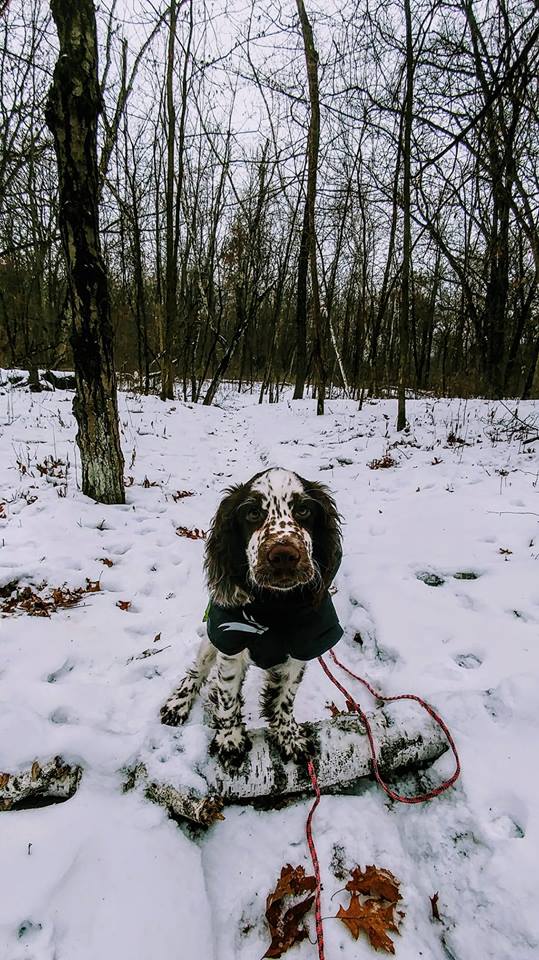
Stand stay on a log in the woods.
Cute pictures are pretty much
 the reason I teach stays at all

Knowing that this is a normal, natural phase of Kaylee's development helps me decide on a training plan. If I had an adult dog who suddenly lost her ability to hold a stay position for any length of time, I would go back to basics - I'd find an amount of time she could hold the position and slowly build up from there. I could certain do this with Kaylee; that's not a wrong plan. But it's also not likely to impact the eventual outcome: as Kaylee matures into a young adult, her ability to hold a straight stay will almost certainly come back on its own regardless of whether I attempt to retrain her stay now. Unless, of course, I screw something up. We must, of course, never discount our human ability to screw up our dogs.

With the understanding that Kaylee has a solid foundation, and in the interest of not screwing up my dog, I could certainly avoid asking her for stays for the next six to twelve months. That's how I handle fear periods. We hunker down, avoid triggers, and wait for the storm to pass.

Six to twelve months is a long storm. I'm not going to stop training. Instead, I'm going to turn on the tv.

Trainers often discuss stays in relation to the Three D's of Fluency: distance, duration, and distraction. As you see, duration is only a part of the picture; I can put it on hold and increase work in the other areas. Duration is difficult for Kaylee right now because it's boring. She's too distractable to think about being still for any length of time, so I will give her other things to focus on. Therefore, I've added a little distance to our stay practice - and a lot of impulse control. We're playing more zen, sticky feet, relaxation protocol, moving stands, and other games that involve holding still while the world happens around her. Of course, there's some duration here, but it's not out primary focus. These impulse control games will also come in handy for Kaylee's next developmental stage:

The dreaded teenager.

Down stay with distance at TSC.

Friday, December 1, 2017

Kaylee, 4 Month Foundations

Kaylee is rocking her foundation training, and we've started a lot of the exercises she'll need to start obedience and rally - so many that I've started to loose track. So here's the list:

  1. Stand (duration + exam)
  2. Down (duration + hand sign)
  3. Sit (duration + distraction)
  4. Retrieve
  5. Go outs
  6. Disc pivots (for heel)
  7. Chin rest (duration + distraction)
  8. Recalls
  9. Zen (hand, floor, food bowl, + sticky feet)
  10. Hand target
  11. Squish

In addition to competition foundations, we've also been working on life skills:
  1. Ear cleaning
  2. Foot hair/nail trims
  3. Clipper vibration
  4. Restraint
  5. Crate games (specifically, waiting to be released before leaving & new places)
  6. Loose leash walking
  7. Reorientation 
  8. Oral exam/cleaning
  9. Mat work (duration, distraction, + new places)
  10. Stationing while another dog is working
  11. Moving to the side of the trail when others approach

So here's where we're going next:
  1. Heeling games
  2. Fronts
  3. Retrieve (objecting holding duration)
  4. Sit/Stand/Down with distance
  5. Recalls with distraction
  6. Zen with high value rewards + more movement
  7. Moving squish
  8. Building distance on go outs
  9. Scent articles
  10. Rear foot targeting
Okay, I think that's everything . . . 


Thursday, November 30, 2017

2. Indoor Brewery Pass: Sociable Ciderwerks

Friday, the Springer Puppy Gang checked another brewery off our passes and went to Sociable Ciderwerks holiday party. I'm not going to lie, Sociable Ciderwerks is one of my very favorite breweries, and I had a blast sampling the different drinks they had available for the celebration: rasberry freewheeler was a favorite, as well as the peach apricot kolsch, and I brought home mulled fat bike and apple for later.

The places was packed, so we got the shit socialized out of us. I was super proud of all the puppies, especially Kaylee because she's mine. And also because she was a rockstar. She didn't seem overwhelmed by the crowd at all, and worked hard on simple positions and matwork even though she was also freezing. We also hit a major milestone: the entire evening, Kaylee took every cookie I offered her. Usually, she gets distracted or isn't that interested, and so usually spits out at least a few. I think her willingness to eat for me at Sociable was less the food drive building work and more that I'm learning what she wants in a situation and how to present it to her, but it was still a big accomplishment for us.

After eating, drinking, and socializing our fill, we went back to Friend Megan's house so I could sober up -er, I mean, so the puppies could play. In addition to Megan's puppy, Earl (who is also Kaylee's brother), Kaylee's breeder (Jamie) brought her new puppy (Gigi). While the puppies played, I was treated to an education in the inner workings of English Springer Spaniels as a breed. I crammed in as much research as I could before I brought Kaylee home, but springers aren't a breed I've been following for years, and there's not much substitution for real conversation with breed enthusiasts.

TL;DR: A fun, entertaining evening where Kaylee got socialized and I both drank (maybe) too much and learned a lot. Win-win!

Parents of toddlers everywhere will recognize this as the universal "NOT TIRED" sleeping position.
Photo credit to Jamie. 

Sunday, November 26, 2017

Kaylee Training, 3 Months

Kaylee has been in our house for almost a month now, and I sure am learning a lot! Working with a deaf dog is just like working with a hearing dog - except when it isn't. One of the training pieces that has surprised me is how little I use our marker, the "thumbs up." The clicker is a much more efficient way to communicate with dogs, and the dog doesn't need to be looking at me to use it. The visual marker is about as efficient as a verbal. So useful, but slow, and I struggle with wasting time while training. More often than not, I've found that simply shoving food in Kaylee's mouth works well, and that's what I resort to, saving out marker for more distance work where it's easier for Kaylee to see all of me rather than just the hand with the cookie in it.

More important than technique, though, I'm learning a lot about who Kaylee is as a dog. For example, Kaylee requires a great deal of positive affirmation from me during training - the food isn't enough. Every once in a while, I have to stop for scritches and snuggles to keep her enthusiasm up. As oppose to the bulls and terriers who couldn't care what I do short of beating them so long as I keep the cookies coming (and even then - how hard a beating are we talking?).

A lot of our focus thus far has been building attention and working drive. I'm using my dismissal cue a great deal. This cue, clapping my hands together and then spreading them and shrugging my shoulders, indicates to Kaylee that I'm done working, and she should go do dog stuff. I try to dismiss Kaylee before she loses focus on whatever we're doing and wanders away. Using a dismissal, I make myself a finite resource - I'm not always going to be available to play, so she should take advantage of my engagement when I offer it. That's over simplifying a bit, but you get the idea. And it's working: yesterday, Kaylee pulled her mat off the table, checked to make sure I was watching, and pointedly laid down on it. And when that didn't work, she found her food bowl and stood in it.

Good little pupper!

Since drive building is going well, I've started shifting the goals of our training sessions with an eye to future competition. I've been using a lot of shaping to help build drive; all else being equal, dogs tend to find puzzle solving interesting (so do people). But there's a danger to having a dog that is too operant - that enjoys solving puzzles too much. These dogs get stuck on the idea that they have to do something to be rewarded. That may not sound terrible, but it's a problem Cannon has. He enjoys shaping so much, he doesn't quite understand that he can do "nothing" and still get cookies. In short, he can't sit still - his stays are rather painful. So Kaylee and I are starting to work more duration with our sit, down, chin rest, and stand positions.

That's the best part about having a fair amount of experience training different dogs. If you're good, you can avoid making the same mistakes over and over again. Instead, you can find new, creative ways to screw up your dogs.


Sunday, November 12, 2017

1. Indoor Brewery Pass: 56 Brewing

It's cool: Kaylee is perfect, and gets more perfect every day.
November in Minnesota is a terrible time to have a puppy. I mean, it's a pretty miserable time up here in general, unless you're a hunter or . . . you know what, I can't even think of what else there is to do in Minnesota in November unless your hobbies include being covered in mud and frozen. It's hard to socialize a puppy when everyone is hiding in their homes trying to stay warm.

Fortunately, the Twin Cities metro area seems to get more dog friendly every year. To get Kaylee out and experiencing new adventures, I picked up Sidewalk Dogs' Indoor Brewery Pass. The pass gets us a free beer and unlimited socialization at ten of the metro area's dog friendly breweries. We also get $10 off at three local pet stores: Bone Adventure, Chuck and Don's, and Lulu and Luigi's. Since the pass is only $25, it pretty much pays for itself right there. Plus, who doesn't need a few adult beverages while raising a puppy?

Yesterday, Kaylee, our friend Megan, Kaylee's brother Earl, and I set out to check off the first brewery on our passes.We chose 56 Brewing as they had food truck, Gastrotruck, serving food on Saturday. I chose the Walnut Joy stout with some of the best meat loaf I think I've ever had. Kaylee and Earl did great for a couple of three month old puppies. They already have some great mat skills, and they're well on their way to being perfect patio dogs. Great puppers, awesome company, good beer, and yummy food made this adventure a winner for everyone. 

Chillin' on their mats like good puppers. 
If you're interested in getting your own Indoor Brewery pass, you can check out Sidewalk Dogs' website here. And if you're stumped on which brewery to hit up first, the folks at Sidewalk Dogs have created a handy, up-coming event list for the breweries on the pass. As a bonus, a portion of the proceeds from the Indoor Brewery Pass go to Can Do Canines, a local service dog organization. So anyway you slice it, this pass is a pretty pawsome deal for everyone.

One more 'cause she's cute.

Monday, November 6, 2017

Deaf Dog Training

Today at lunch, a few of my coworkers were asking me about what it's like to train a deaf dog. Essentially, it's just like training a hearing dog. Except for the parts where it's not.

So I videoed part of today's lesson on mat work so I could show you what I meant. And then I cropped out the bits where I look like an idiot.

The goal of mat work is to have a dog who settles on a mat - in this case, a fleece blanket - in a variety of different environments. For my normal dogs, I use their mats as a place to be when we're out in public and I need to split my attention between them and another activity. For example, I have them lay on their mats while eating outside with friends. For my, um, less normal dogs, the mat is a safe space where nothing bad will happen to them. Having a portable safe space is invaluable for places like the vet.


In this video, I'm using a thumbs up as a marker - a way to communicate to Kaylee that she's done something I like and want her to repeat. For my hearing dogs, I use a clicker or a verbal "yes." I've found that the problem with the thumbs up is, of course, that Kaylee needs to see it. This is a bit of a problem because the first step in mat training is to mark the dog for looking at the mat.

It's possible you see my dilemma.

I miss my clicker. But we persevere! The goal of a marker is to give the dog instant feedback on their behavior, and so in situations like this where I can get food into her mouth while she is doing what I want, sometimes I skip the marker. You can see in the video that it's working. Kaylee definitely has some idea that interacting with the mat makes cookies happen. And so learning happens.

However, the real lesson here is much more subtle and much, much more important than simple mat work. Kaylee is learning one of the most crucial concepts of her entire life - that working with me is interesting, fun, and very worth her while. Kaylee is not a particularly food motivated dog. She likes food, but she's also very invested in her environment, the other dogs, other people, and oh, hey, look! A shiny, tinfoil squirrel!

Building a strong foundation of enjoyable work - an investment in working together as a team - is going to take us a lot further in competition and life than any amount of cookies or punishment or shiny tinfoil squirrels ever will.


Sunday, November 5, 2017

Kaylee Ann


Allow me to show you the newest, permanent addition to the horde.

Now, I know what you're thinking, friends: "WTF. Laura, that's not a terrier or a bulldog!" How very astute of you, friends! You are quite correct. This little lady is actually an English Springer Spaniel.

Part of growing up means realizing that you will never own all of the different types of dog you would like to. While "springer spaniel" has never made it onto my short list of breeds to get before I die, she does have one very important characteristic that *is* on my short list.


You see, this perfect little girl happens to be completely deaf.

Many of you who have listened to me describe my next dog over the past several years will realize that this puppy and the puppy I thought I would have are very different. There's a long story behind that, with more than a little heartbreak, and a lot of right-place-right-time. Suffice to say that I am very pleased with this addition to our home, and I'm excited to go on all the adventures the future has for us.

As the great philosopher once said, "You can't always get what you want. But if you try sometime, you just might find you get what you need."

ARCH Allister


I gave up on this dog.

So many times my heart aches to think of it. For years, our training sessions ended both of us screaming at the other – literally. More than all of the other dogs combined (and that’s a lot), this dog has brought me to tears again and again. I considered rehoming him several times. But like a bad habit, I couldn’t give him up.

So we grew up together. We measured progress not in steps forward or back, but in how little or much we hated the other –or not - at the end of the day. And day by day, our relationship repaired. And finally grew. Allister is my Ferrari dog, and like a really good sports car, once I figured out how to drive him, he took me on one hell of a ride.

Like many titles, this championship is not a handful of letters, but a lifetime achievement: a testament to not giving up. All ten of Allister’s runs for this trial placed in the ribbons. Every Single. One. And every single leg brought us either High in Trial or High Scoring Mixed Breed. In addition and true over-achiever style, our trail yesterday bought us both High Scoring Mixed Breed and High Scoring MMBC Member with two runs of perfect 210s. Nine of his ten runs were over 200. I am still in awe.

Allister has taught me that it is not breed or age or even time spent training that counts the most. It is relationship – who you are as a team – that is the most crucial aspect of competition.

And I am so very, very proud to be Allister’s teammate.


Monday, February 13, 2017

Staycation in Motion, A+14: Integration

And so things have returned to normal here at the Horde House - or as close to normal as anything can be with seven dogs living under the same roof. Everyone is more or less integrated now. Cannon is still irritated by the new comer, and so will get frequent breaks away. Rubi, as always, bears careful monitoring with any dog that doesn't know her quirks, and so she and Abe will be separated for a bit yet unless we are directly watching them. But overall, everyone can be out together at the same time.


Abe has made great progress in the past two weeks. He's comfortable in all the rooms of the house, plus the back yard, and we've started on the garage. He has a few basic manners (although he also maintains a fondness for buckles). He's figuring out the house training thing. Most importantly, Abe has a place to come back to that feels comfortable and safe. This is going to be very important in the coming weeks.

Abe is not healed. He still has a long road ahead of him, full of scary and unpredictable things. I have not "fixed" the neglect he has experienced. What I have done is give Abe a firm foundation to rely on and build upon as he goes on with his life. I have shown him that there is good in the world, and now that good is a part of him.

Wherever he may go.


Sunday, February 12, 2017

Staycation in Motion, A+13: Leveling Up The Training

Abe has had a full dance card today: we've hung out with Piper Ann and Cannon, and then Allister. I expected Abe to be a little more interested in the other dogs than he has been, but I'm not at all concerned about how any of the dates have gone. More impressively I am happy to report that Abe has begun exploring the backyard on his own instead of remaining in a five foot radius of my legs. Curiosity is a good sign.

So that's the theme of today's post: curiosity and creativity. I want to teach Abe courage; I want him to learn new ways of interacting with the world around him. Abe has done very well with formal training so far. He mostly knows sit, and he's doing great at hand targets and chin rests. These are all lured behaviors, so they don't involve much thinking on Abe's part. He only needs to follow the treat. Now, I want to encourage creativity and problem solving, so our next project is to learn by shaping.

Shaping is the "hot or cold" game. I have an image in my head of the behavior I am looking for, and I'm going to break the behavior down into little steps. Then, I will mark and reward each step up to the finished behavior. It's the dog's job to figure out what behavior I'm looking for. Originally, I was going to start with mat work, but someone else mentioned that they're having crate trouble with crating, so I'll use that instead. Turning crate time into a game often helps dogs feel happier about their kennels.

So, we'll start by breaking down the process of crating into little steps:


  1. Look at the crate.
  2. Step toward the crate.
  3. Take more steps toward the crate. 
  4. Put your head in the crate. 
  5. Put one foot in the crate. 
  6. Put two feet in the crate
  7. Put three feet in the crate.
  8. Put ALL the feet in the crate. 
  9. Stay in the crate for a couple of seconds.
  10. Stay in the crate while I close the door. 
  11. Stay in the crate for longer amounts of time.
Now we have a bog behavior - crate training - and we've broken it down into eleven steps. If the dog is struggling, you can break it down ever further. What's smaller than a step? How about a lean in the direction of the crate?

For each step, I wait until the dog is performing the mini-behavior consistently before advancing to the next level. So for example, I wait until the Abe is offering me both feet in the kennel nine times out of ten before I start waiting for three feet in the kennel. So what happens if Abe skips a step and puts all four feet in the kennel? Jackpot! Instead of handing out one treat, I pass out five or ten. Congratulations, dude, you're brilliant!

And then I stop the training session. It's important to keep shaping sessions short and sweet, particularly if the dog is struggling. Remember math class? Don't you wish the teacher would have given you a couple of easy problems and then let you go home afterward? Be like kindergarten addition, not college calculus. Frequent breaks also take advantage of of latent learning, where a dog (or person) takes the session, thinks about it for a while, and then comes back sharper and with new ideas. Latent learning is the lazy dog trainer's best friend. 

Shaping will help to create new neural pathways in Abe's brain (I have science to back this up, but I'd have to go dig it out of whatever rock I put it under, and I have other things I need to get done today). It teaches him new ways of interacting with his world. It will also teach him persistence and creativity in problem solving. Currently, Abe has one solution to problems: he freezes and hopes he doesn't die. But if I can get him to consider other ways of behaving, I think he'll find that the world isn't such a scary place. In a way, I'm hoping to teach Abe that the world isn't full of problems to hide from - but it is full of challenges to be overcome. 


Saturday, February 11, 2017

Staycation in Motion, A+12: Platypus Dates

Once the dogs are interacting as closely as I can manage - and no one seems unhappy - I start arranging play dates. Now, play dates at my house are going to look different than play dates at your house. Mixing and matching seven dogs takes a bit of finesse, but many of the basic principles are the same across staycations.

Before I start introducing dogs without the aide of barriers, I make sure to set everyone up for success. If I'm concerned at all that dogs might not get along, I enlist an extra set of hands to help with the play date. I'll also have the dogs drag leashes so that if there is a fight, the dogs are easier to separate. I use our backyard for play dates as it's a larger space. This means the dogs have room to be as close or as far from each other as they would like. Last, I have a handful of treats available to distract or reward as needed (if the new dog has issues with food around other dogs, I will have picked up on it when I was passing treats out at the baby gate earlier).

I always introduce dogs to Piper Ann first. Of my dogs, she is the most chill. She's also the most responsive to my cues - if I ask her to come to me, she will drop whatever she's doing and come right away (mostly). Ideally, I want play dates to go the same way uncovering the baby gates did: a couple of friendly sniffs, and then move along, little doggies. Nothing to see here.

Of course, some times play happens on play dates. I don't stop play immediately, but I do watch very carefully to make sure it's healthy play. As I mentioned earlier, play is arousing, and it's easy for play-arousal to turn into fight-arousal. Unless the play I am observing is extremely comfortable and the dogs are playing like long lost friends (this has never happened to me in approximately a billion years of fostering), I interrupt play every ten to fifteen seconds by passing out treats.

What does healthy play look like?

This is going to take longer than a paragraph to answer. There are actually hours long seminars and lectures on the topic. But there are a few things I look for. Is the play equal? Are both dogs having fun? Dogs who are strangers will trade rolls. For example, if they are wrestling, they should be sharing time as the dog jumping on top of the other and the dog closer to the ground. I also watch for calming signals. Good play should have calming signals, and the dogs should mirror each other's signals. So if one dog stops to sniff, the other should stop to sniff as well. For play to be healthy, the dogs should naturally interrupt themselves, just a few seconds every fifteen seconds or so. If the dogs aren't interrupting themselves, then I definitely need to step in.

Frequent interrupting helps keep arousal levels low and under control. The longer dogs play without interrupting, the higher the risk of play turning into a dog fight. If dogs are just chilling in the same yard, the first play date will last about twenty minutes. If dogs are playing, I'll stop the date after about ten minutes - less than that for intense play. If the first play date goes well, I will start gradually increasing the amount of time dogs spend together. However, I will always error on the side of keeping things sort and sweet. A dog fight at this point can be disastrous, and you may end up spending months repairing a bad first impression.

At the risk of sounding redundant: you have nothing to lose by going slowly. You have everything to lose by moving too quickly.


Thursday, February 9, 2017

Staycation in Motion, A+10: Separation Anxiety

Once the baby gates are uncovered and if everyone is still happy, the next step is to bring the dogs closer together. There's a few ways I do this is our house. For example, I'll crate Abe or a couple of the other dogs in the same room, and then we'll all hang out and watch a moving. Another exercise we do is bringing everyone up to the baby gate and then passing out treats. This point in the Staycation is also where I will often move the foster dog's crate into the main bedroom.

Abe's crate is staying in the second bedroom.

Genetics being equal, dogs who have been bounced around or experienced early trauma are more prone to developing separation anxiety. This risk increases if you do something like let your foster dog bond with you. These dogs have had people they've bonded with disappear on them before, so I think they get worried people will leave them again. Or in Abe's case, he's never had a healthy human relationship, and he's not sure about this whole current-love-of-my-life leaving thing. Abe also has another risk factor - he's probably always lived with other dogs. He's never had to learn how to be alone. Alone is often a difficult idea for dogs.

Abe does not have separation anxiety. He makes angry bulldog noises for a few minutes after you leave him in the crate or if he hears people that sound like they're having more fun than him, but that's pretty normal behavior. On the other hand, I know for Abe's history and his risk factors. I weighed the benefits of bonding versus the risk of separation anxiety and felt it was worth it. And I can't change the rest. However, I want to prevent real separation anxiety from developing, so I'm going to continue giving Abe the opportunity to practice being alone in his crate at night and while we're away from home. I need to be particularly mindful of creating time for Abe to be alone as we relax the Staycation and start spending more time together.

It's hard to manage introductions and a camera at the same time,
so here's a picture of Abe tasting a cat instead. 

Wednesday, February 8, 2017

Staycation in Motion, A+9: Baby Gates and Picture Windows

Once the dogs pass the glimpse through the baby gate phase, the next step in introductions is more exposure. I gradually lengthen the amount of time the blankets are off the baby gates. Typically, this can take a couple of days, but Abe is doing very well and will be ready to tackle the next step in relaxing our crate and rotate protocol tomorrow.

The cats, for their part, are please to have a new way to torture a dog that doesn't understand their games. Yet.


Tuesday, February 7, 2017

Staycation in Motion, A+8: Breath Deep, Go Slow

I can't tell you how to crate and rotate. I don't know you, I don't know your dogs, I don't know the dog you are trying to integrate into your family, and I don't know the layout of your house. I can tell you how I crate and rotate, though.

For the last week, my home has been in the midst of what I call "full lock down" crate and rotate. This means that dogs don't even get to see each other. Now, I'm not fooling anyone here: my dogs are well aware that there is a stranger in their house, and Abe knows that the other dogs live here as well. The point of "full lock down" is to give the dogs a chance to gather information about each other without forcing them to interact. It's breaking introductions down into the smallest possible steps. The smaller we can break down introductions, the less overwhelming they will be. The less overwhelming introductions are, the higher the chance of success.

I have nothing to lose by going slowly. I have everything to lose by moving too quickly.

The crate and rotate set up in my house involves several baby gates. In lock down, the baby gates are covered by blankets. For us, the first step in relaxing our system is to get rid of the blankets. I start by pulling part of the blanket away for fifteen to thirty seconds. I'll do this three or four times the first day to make sure I'm reading all the dogs' signals correctly.

What I like to see is that the dogs notice each other, maybe sniff a little, and then move on with their business. That's perfect. The dogs are telling me that everything is cool, and they're ready for the next step.

Sometimes, though, that's not what I get. When I brought Marnie into our house, she completely ignored the dogs on the other side of the baby gate. No sniffing, no looking, no interaction at all. Marnie, if you remember, had anxiety around other dogs. When I started pulling away the blankets, Marnie started playing ostrich - if she didn't notice the other dogs, they weren't really there. If they weren't there, she didn't need to be afraid of them. Marnie was sticking her head in the sand. She wasn't ready to push things further, so she stayed at the "brief glimpses" stage of the Staycation for several days (almost a week, if I remember correctly). When she started watching the other dogs, I knew she was ready for the next step.

Another common reaction to seeing each other at the baby gate is that dogs will start to play with each other. I'm not crazy about this behavior, but I'll take it. Play indicates a higher level of arousal; the dogs are more excited. For our socially awkward bullies in particular, there's a fine line between play arousal and fight arousal. I want introductions to be as boring as possible. If dogs start playing, often I'll hang out here for another day or two to see if they calm down.

The last behavior I commonly see at this stage is that dogs will get tense and start to snark or fight. The moment I start to see tension between the dogs, I cover the baby gate again. This pretty clear language from the dogs: they're not ready for this stage. If I get tension or snarking, I cover the baby gates and don't uncover them again for at least another full forty-eight hours. Remember, I have nothing to lose by going slowly. The dogs will tell me when they're ready to move on.

So how did Abe do? Well, he sniffed at the baby gate, watched the other dogs for a moment, and then wandered away to go chew on the buckle on my backpack. My dogs didn't even bother to get up from the couches. Perfect. Well, except for my poor backpack.